Improving System Sustainment through an Integrated Modeling Schema Coupled with Effective Execution of the Lifecycle Sustainment Plan
Co-authored by David Sathiaraj (CTO) et al., the report examines how connected modeling and simulation can strengthen the execution of a Lifecycle Sustainment Plan.
Research focus
The research paper describes traditional and AI-based models used to develop predictive analytics for platform lifecycle decisions, using the Columbia-class submarine program as context. The central capability is planning across two horizons at once: projecting workforce needs by job, shop, and facility and material needs across parts and the vendor supply chain over a fifty-year lifecycle, while also supporting immediate planning for an upcoming maintenance availability. What-if scenario planning and adjustable policy levers let planners test how a change in one input moves outcomes across both horizons.
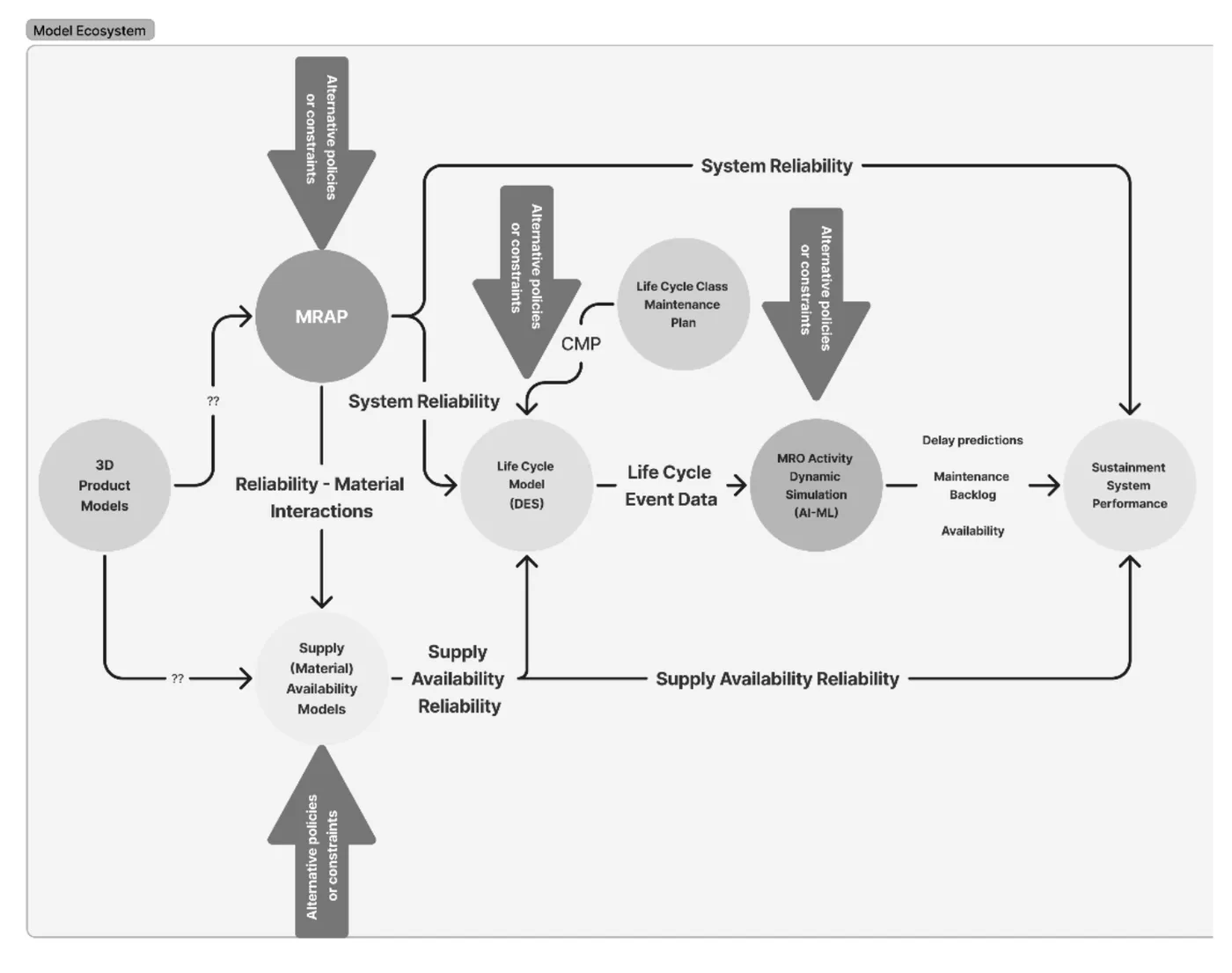
The modeling schema: product and reliability models feed a discrete-event lifecycle model and the supply chain, an AI and machine learning simulation of maintenance activity returns delay, backlog, and availability, and reliability signals close the loop. The four wide arrows are the policy levers a planner moves in a what-if run. Figure 1 from the report, Acquisition Research Program, Naval Postgraduate School.
This modeling schema is the foundation for CREST, Ridgeline’s readiness intelligence platform. Ridgeline now applies it across ships, submarines, aircraft, munitions, and civil works for defense customers, and extends it to commercial customers tracking workforce, equipment, and infrastructure readiness.
Publication
The Acquisition Research Program at the Naval Postgraduate School published the report on May 1, 2025 as part of the Annual Acquisition Research Symposium.