Improving Predictive Accuracy in Elections
Co-authored by David Sathiaraj (CTO) et al., this paper presents a continuous individual-level scoring approach to election forecasting.
Research focus
The research paper describes combining static, historical voter-registration data with changing inputs such as volatile polling and donor data to assign individual voter scores and estimate vote counts under different turnout scenarios. Tests on U.S. Senate and Louisiana gubernatorial elections produced forecasts within 1% of actual results several days before voting.
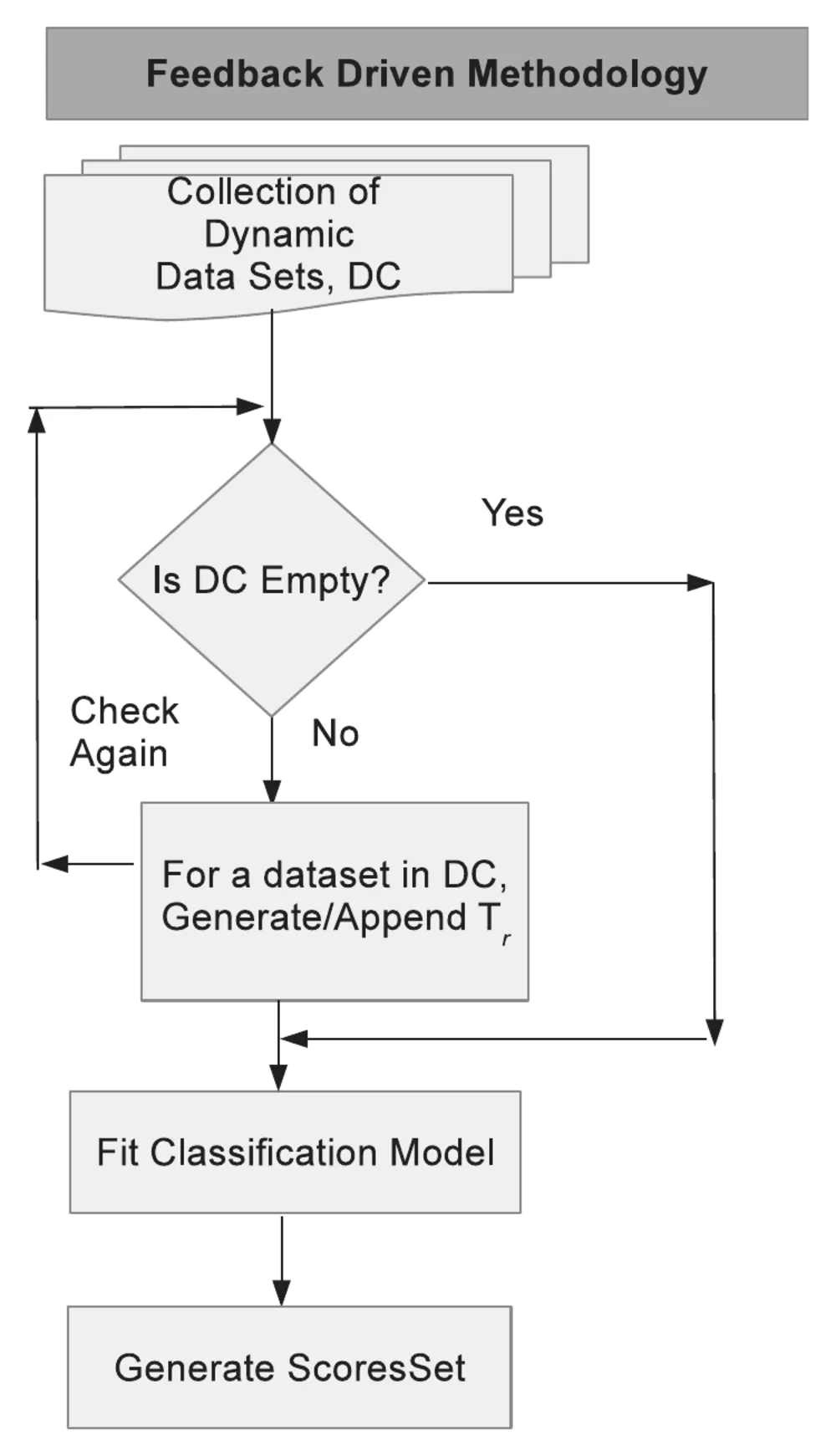
The scoring loop: each new poll, canvass, or donor file is appended to the training set, the model is refitted, and every individual score is regenerated. Scores update as each new signal arrives. FIG. 4 from the paper, Big Data 5(4), 2017.
The underlying method is behavioral analytics at the individual entity level: a stable baseline profile scored continuously against fast-moving signal, aggregated into a forecast. That structure transfers to any domain where behavior shifts faster than the review cycle that measures it. In credit, it supports perpetual grading of loans, scoring individual obligors as new filings and market data arrive. In supply chain, it enables continuous scoring of businesses whose viability is highly sensitive to external shocks, including tariff and trade policy changes that can move a supplier’s risk profile within a quarter. In retail, it reads hypermarket buying-demand signals at the SKU and store level to inform what to hold in inventory and what to scrap.
Publication
The paper was published in Big Data, volume 5, issue 4, pages 325–336, in December 2017.