On Identifying Critical Nuggets of Information During Classification Tasks
Co-authored by David Sathiaraj (CTO) et al., this paper introduces critical nuggets: small collections of records that carry outsized value during classification tasks.
Research focus
The paper proposes a domain-independent way to measure criticality and a heuristic that reduces the search space for finding critical subsets. The research validates the approach on real-world datasets and examines how it can improve classification accuracy while reducing false positive and false negative errors.
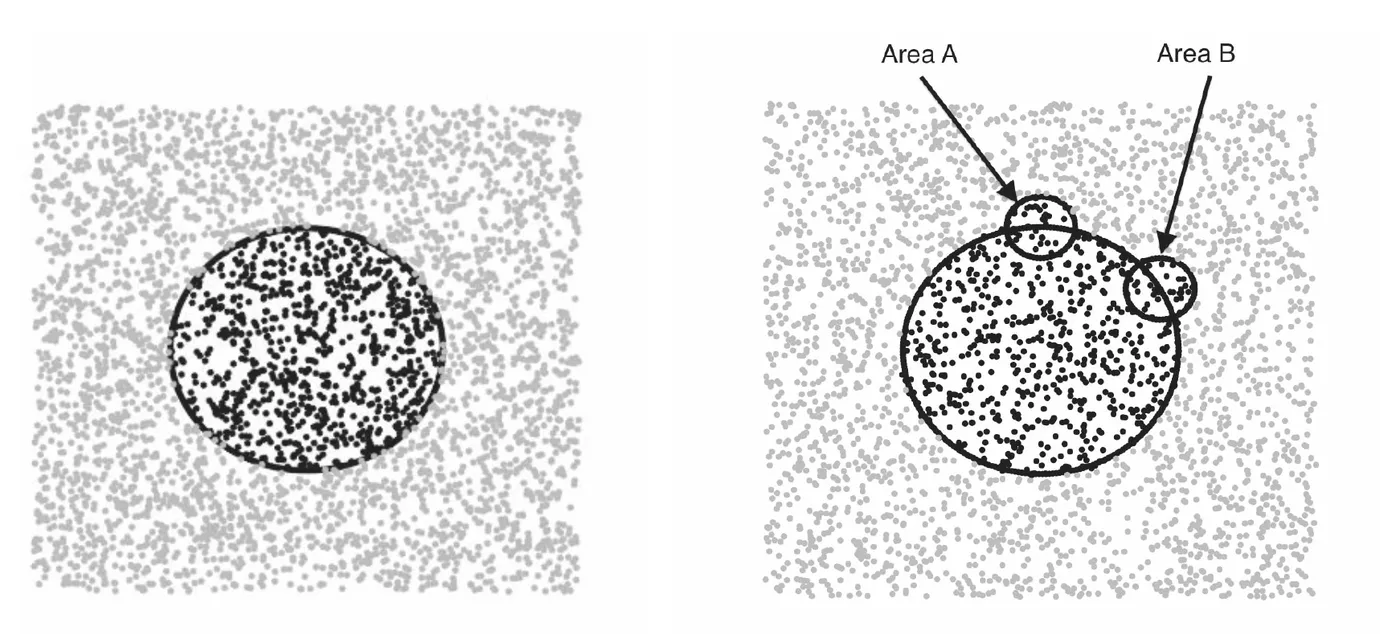
Grey dots are one class, black dots the other. The plain circular region on the left carries no critical subset. The protrusions on the right, Area A and Area B, sit on the class boundary and hold the records whose small attribute changes switch a classification. Fig. 1 from the paper, © 2013 IEEE.
That same logic now underpins how Ridgeline’s AI platforms triage large data volumes in production. CREST, Ridgeline’s readiness platform, surfaces the maintenance logs most predictive of a readiness drop and supports what-if planning of maintenance availabilities. For businesses facing supply chain disruption, agentic AI paired with critical nuggets approaches supports what-if scenario planning by isolating the nodes and lead-time signals that change an outcome. In hypermarket transaction data, the method separates the SKU and store-level movements that warrant a replenishment change from routine variation. In credit, it drives dynamic loan screening by identifying the borrower records whose characteristics carry the greatest weight in a default classification.
Publication
IEEE published the paper in IEEE Transactions on Knowledge and Data Engineering, volume 25, issue 6, pages 1354–1367, in June 2013.